Copy bots for Polymarket Beta
Copying is easy.Copying the profit is not.
The result is decided before you start — by who you copy, how much you bring, and how late you arrive. None of that is guesswork: we put a number on each, and you see all three before the first dollar.
DRY RUN repeats the trades on paper — no real orders.
Three steps from the catalogue to a working bot.
A bot repeats the trades of one public Polymarket wallet — one bot, one trader, one wallet you own. Getting there takes three steps, and only one of them can cost anything: nothing is paid and no wallet is connected until you press start in LIVE.
Prefer clicking to reading? Walk the same three steps as a tree — every fork, at the end of this page.
Pick a trader
✓ costs nothing · no registrationA leaderboard ranks by profit — the one thing that does not transfer to you. Our screener does the opposite job: it clears the accounts nobody could copy out of your way, then lets you narrow what is left by the criteria you actually pick a trader on — what keeping up with them costs, how fast they trade, which markets they trade, how long they hold.
- Structural operators
- negRisk baskets
- Rewards, not direction
- Sub-second scalpers
- Price extremes
- Gone quiet
- Sells tails
- Longshot bets
- Crypto scalping
- Fragmented orders
- Maker rebates
- Fast tempo
- negRisk suspect
- One lucky market
- Deposit for a one-to-one copy
- Smallest deposit that still repeats every trade
- What your amount reproduces, by decisions and by volume
- From what size their trades start being copied
- Trading fees at your scale
- Which of their trades fall away at your size, with examples
- Their portfolio today is not the deposit you need
- Nothing to copy in the window means no verdict, not “fits fully”
- Their style, described rather than scored
- The risks of copying this particular trader
- Anomalies worth knowing about
- A call: worth copying, copy with caveats, or better avoided
- How sure it is of its own data
- When the numbers contradict each other it says so instead of inventing a verdict
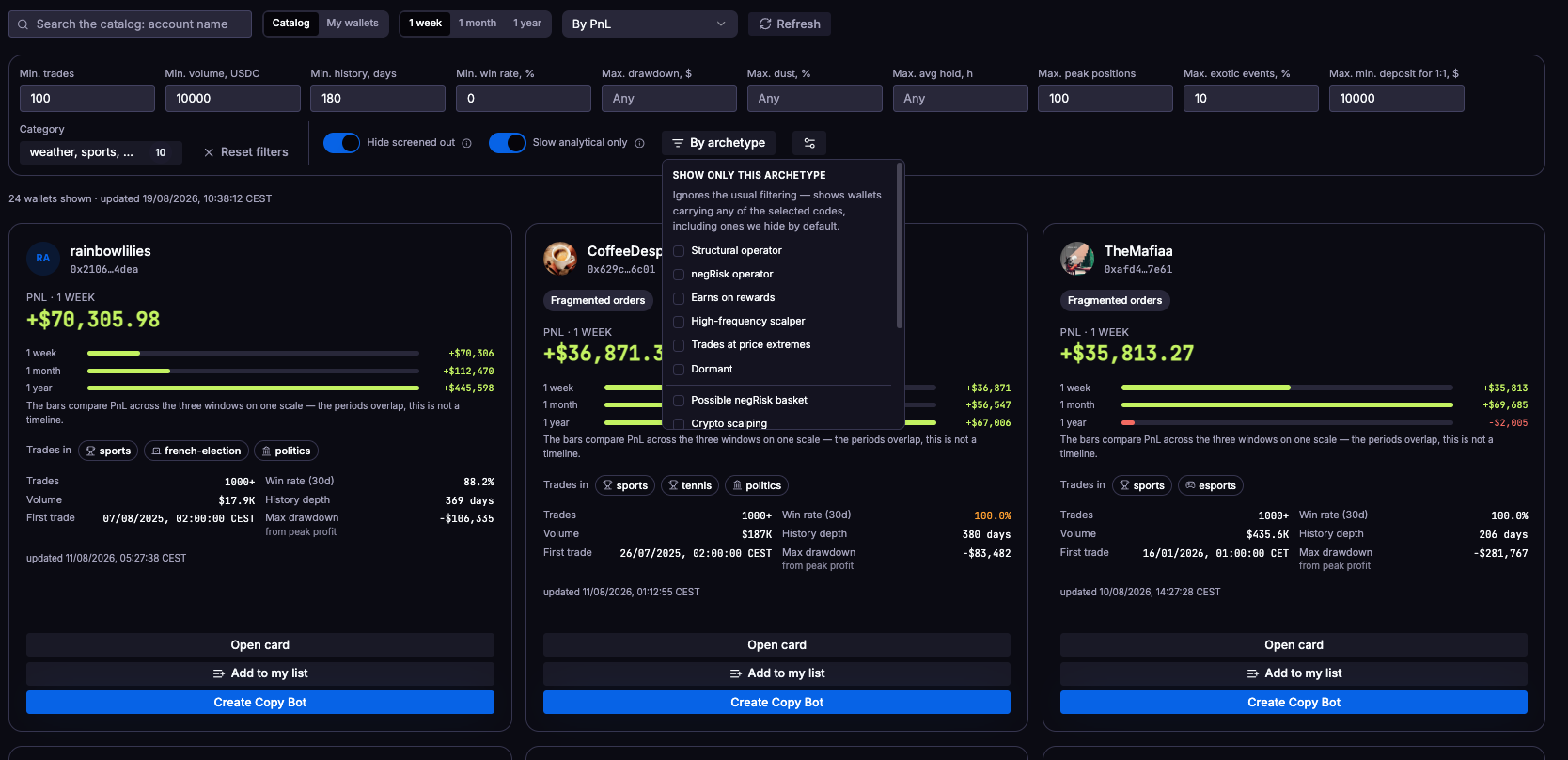
The number a leaderboard sorts by is the one that survives being copied worst. Here is that failure, counted across the catalogue rather than argued.
Set it up and start it
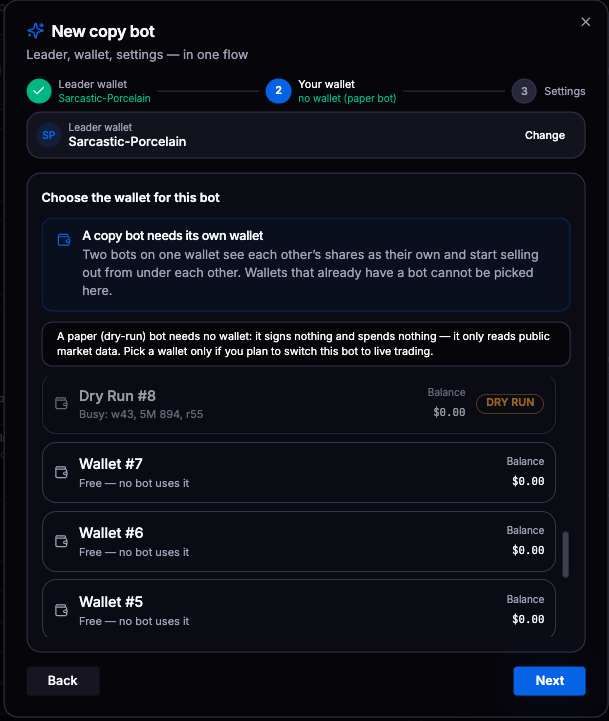
✓ still free · nothing to connect yetTwo screens, and both arrive with the work done. The wallet step only asks which wallet this bot gets — or none, if it is going to run on paper. The settings step arrives already filled in from the leader’s own recent history, with the reason for every number written under it. Then you press start, and the mode is a choice you make at that moment.
A copy bot needs a wallet nobody else is using — two bots on one wallet would read each other’s positions as their own and start selling out from under each other. A paper bot needs no wallet at all: it signs nothing and spends nothing.
Watch it work
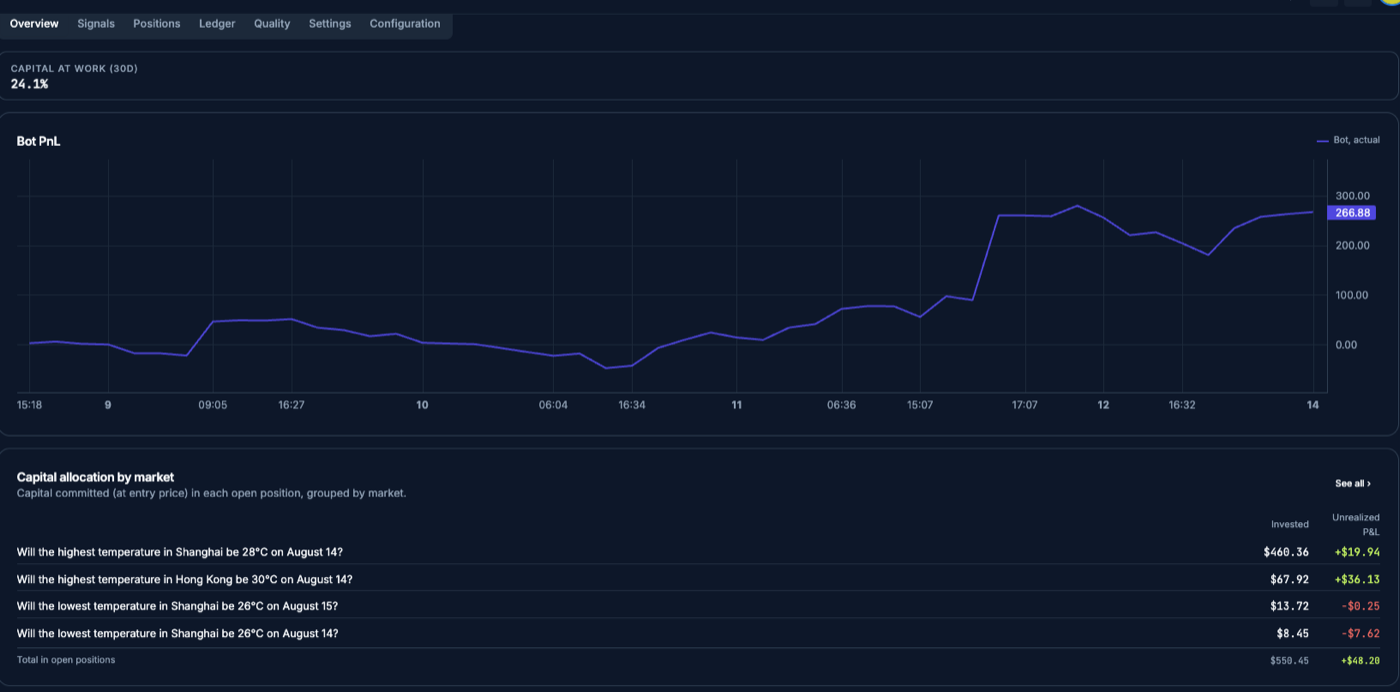
✓ same views on paper and on liveWhatever the mode, the same surfaces answer the same questions: what it holds, what it did and why, how far it drifted from the leader, and what that difference cost. Every decision is on record with the rule that produced it.
The bot’s own result over time and the capital committed to each open position, market by market. The first screen you open and the one you keep coming back to.
The whole path, and every choice in it.
Walk it yourself: seven forks, what each one decides, and where it lands. The roads you do not take stay on the picture, so you can go back and take one instead.
Where do you look for a trader?
A copy bot follows exactly one wallet, and that choice outweighs every setting that comes after it. There are two ways to reach a wallet, and they differ in how much the platform has already done for you.
Every fork above exists on the platform today, in this order and in these words. DRY RUN runs the whole engine on live signals — catalogue, passport, feed, quality and portfolio — before the first cent.
Start at the first fork — freeThe choice was one moment. Checking it is not.
A screener verdict is a photograph. When you press start, his profile is frozen — the prices he buys at, his pace, his typical size, where his profit comes from, and the edge of the part of him you can actually copy. After that the platform keeps taking fresh photographs and comparing — as often as every half hour for a busy trader, once in six hours for a quiet one, because the trigger is his own trades and not a calendar. Eleven named checks; none of them is a score.
- His manner — five checks: drift into favourites, leaving the price band he was picked in, pace, typical bet size, where his profit comes from
- The copyable edge — three: the slice you can actually reach, how much more of the move he keeps than you, whether his edge moved out of reach
- Your own copy — three: your drawdown, your entry against the platform’s measured norm, how many of his entries your bot repeated
- One side warns, the other confirms. It is the agreement between them that counts, not how many checks fired
- One check gets here on its own: your drawdown past the envelope built for this bot — by then it is not a warning but a breach of the model
It flags, and it calls you. It does not stop the bot — that stays with the drawdown limit you set yourself and the bot’s own emergency stop. Nor is it a promise to catch a trader going bad: on the platform so far it is the copying side — coverage and drawdown — that trips far more often than his manner does. And a single odd recalculation is not a signal:
Before you decide.
The three steps showed how it works. These are the things people actually ask before starting one — what it will not do, what holds your money when the trader does something stupid, and where every number on this page comes from.
Why don’t you just show me the most profitable traders?
Because profit is a poor guide to what you can reproduce. The top of any leaderboard is crowded with scalpers, basket operators and reward farmers — and the win rate itself gets prettier the smaller the sample: across the catalogue 60% of wallets with a single closed trade show 90%+ wins, against 15% of those with thirty or more. We rank by copyability instead, and show the reason behind every verdict so you can disagree with it.
How much money do I need?
It depends entirely on the trader, which is what the passport is for: it replays his whole history as a cash account and names the deposit that repeats it one-to-one, plus what a smaller amount reproduces by decisions and by volume. The catalogue median is about $979, but the spread runs from a few hundred dollars to roughly ten million.
Can I try it without funding anything?
Yes. DRY RUN runs the whole engine on real live signals, needs no wallet and places no orders — and every screen in step 3 works the same on paper as on live. The mode is not stored in the bot: you pick it again at every start, so a paper bot cannot quietly become a live one.
What does an executed trade actually cost?
Three things, itemised per trade in your dashboard rather than folded into one number: Polymarket’s own taker fee — largest near 50¢ and close to zero at the extremes — our platform trading fee, and about $0.001 of gas per transaction on Polygon. On top of that, $4 per bot per month above the free plan.
Will it pick up positions the trader already holds?
No. The bot starts when you start it and never enters positions the trader already holds. When they sell one of those, your bot has nothing to sell, and the feed says exactly that. Zero trades in the first hours is normal — it means the leader has not traded yet.
Why does my bot skip so many signals?
Almost always because you told it to. Across every bot on the platform over 30 days, 32.0% of skips came from a single setting — the cap on how many markets a bot holds at once — then entry filters, price tolerance and signal age. Raise the cap and you copy more but spread capital thinner. Every skip carries the rule that fired, and the feed links to the setting behind it. One line no setting can fix: a trade below the exchange minimum will not pass under any configuration — that is exchange physics, not our parameter. Genuine failures are labelled apart from skips: those are a problem, not a setting.
Will my result match theirs?
No, and anyone who promises otherwise is selling something. Your order arrives later, at the price the book gives at that moment, and your filters remove some of their trades. We measured the entry penalty on 2,229 copy executions matched to the leader’s own fill by order id: median +1¢, p90 +2¢ — which below 15¢ is a fifth of the price and mid-book 1.5%, and on cheap tokens the tail runs to 3¢. The difference here is that the gap is measured and shown, per bot and across the platform, rather than hoped past.
Will the bot copy exits too?
Yes, exit copying is a setting. On top of that the bot has its own take-profit, stop-loss and circuit breakers that do not depend on the trader, and any position can be closed by hand.
What if the trader starts losing, or disappears?
You are not tied to their exits — your own thresholds and limits apply whatever they do. If they go quiet the bot simply waits: there is nothing to copy. When the silence runs far longer than their own rhythm, or the account empties, we email you.
Does it stop me over-concentrating across several bots?
It shows it, it does not stop it. The portfolio view is computed across all your bots at once and specifically flags markets held by more than one — “the risk adds up” — so five copied traders leaning the same way is visible. What we do not have is an automatic cap across bots: the ceilings live inside each bot, on its own wallet, and cannot fire on your behalf. We give you the number; the decision stays yours.
Am I giving anyone access to my money?
No. The bot trades a wallet you own. Its trading key is encrypted with AES-256-GCM and decrypted only inside an isolated signer, at the moment of a trade, and it can do exactly one thing: trade on Polymarket. Withdrawals go only to the address you registered and require your MetaMask signature — a payout cannot be redirected, not by us and not by whoever holds your password.
What stops the bot when the trader does something stupid?
Three guards you set per bot, which answer to your thresholds rather than to the wallet you follow. Take-profit and stop-loss close the position whatever the trader is doing. The daily loss limit stops the bot opening anything new once the day’s losses reach your cap — and tells you that is why it stood still. The drawdown limit is the same guard across the whole run: drift too far from the peak and no more risk is added instead of chasing it back.
What can I not turn off?
Two things. The circuit breakers live on the platform side, not in the bot’s settings: you can make them stricter, you cannot remove them. And one wallet carries one bot — two bots on a wallet would each read the other’s positions as their own; the wallet can only be changed while the bot is stopped.
What happens if I change a setting while the bot is running?
Nothing, until you restart it. A running bot reads its settings once, at start, and keeps trading on the old value. The panel says so plainly, showing “running with” the old number next to every field that has moved.
The win-rate chart in step 1
Every catalogue wallet with at least one trade closed inside the 30-day window — 13,011 of them — bucketed by how many trades actually closed, then the share of each bucket showing 90%+ wins. A separate 3,129 wallets carry a win rate with no closed trade behind it at all; they are excluded rather than counted as perfect.
The deposit chart in step 1
Each wallet’s history replayed as a cash account: the deepest point it ever reaches, plus a 10% buffer. Computed for the 16,000 wallets with enough history to estimate, and drawn on a log scale because the spread runs from hundreds of dollars to about ten million.
The skip funnel in step 3
All 94,157 skips recorded across every copy bot on the platform in 30 days, grouped by the rule that fired. Not sampled and not per-bot — one bot with a tight position cap would otherwise dominate the picture.
The entry penalty in step 3
Not modelled: 2,229 copy executions matched to the leader’s own fill by order id, and the price difference taken in cents per share. The sample’s own limitation is stated in the disclosures at the foot of this page.
When was all of this measured?
On 19 August 2026, on production data, across every wallet and every bot on the platform rather than per account. The figures are restated on this page as the platform grows — the previous set was taken on 15 August, and every one of them had already moved.
DRY RUN needs no wallet and places no orders. Everything on this page is open before the first cent.
Try it in DRY RUN — freeThe bots in those screenshots run without real orders: same engine, live signals, paper money. The platform says so by itself — its own “Simulated” badge sits on the result card and every bot in the list carries a mode label.
The +1¢ figure is measured on bots that run the whole engine and fill against the same book without moving it. For small clips the difference from a real fill is minor, for large ones it will not be. The number is recomputed as real fills accumulate: the previous set, taken on 567 executions, made the 15–30¢ band look free of any penalty at all — it is not. Last measured on 19 August 2026, on 2,229 executions.
Copy bots are in Beta. Trading prediction markets involves substantial risk and you can lose the money you put in. Copying another trader does not remove that risk and does not reproduce their result: your orders execute later, at different prices, and under your own settings.
Copyability verdicts and analyst reports are informational, are computed from public Polymarket activity, and are not a recommendation to copy any particular wallet. Past performance of any trader or bot is not indicative of future results.
gogobots provides software, does not offer investment advice, does not manage funds and does not recommend whom to follow. Availability may be restricted in your jurisdiction.
Платформа Gogobots