Strategy builders and indicators
Updated: 2026-11-14
A strategy is a set of rules: when to enter, when to exit, and when to stay out of the market. You build it from fields and lists, with no code. There are two builders, because the markets differ:
- Up/Down constructor — for Polymarket Up/Down contracts. Prices are probabilities from 0 to 1, and each contract resolves at a fixed time.
- Multimarket strategy builder — for crypto (spot and perpetual futures) and stocks & derivatives. Classic bars, symbols, orders and portfolios.
Both open in the backtester’s Constructor window, so you can edit, save and run in one place. Each save with new parameters becomes a new version on the strategy card.
The Up/Down constructor
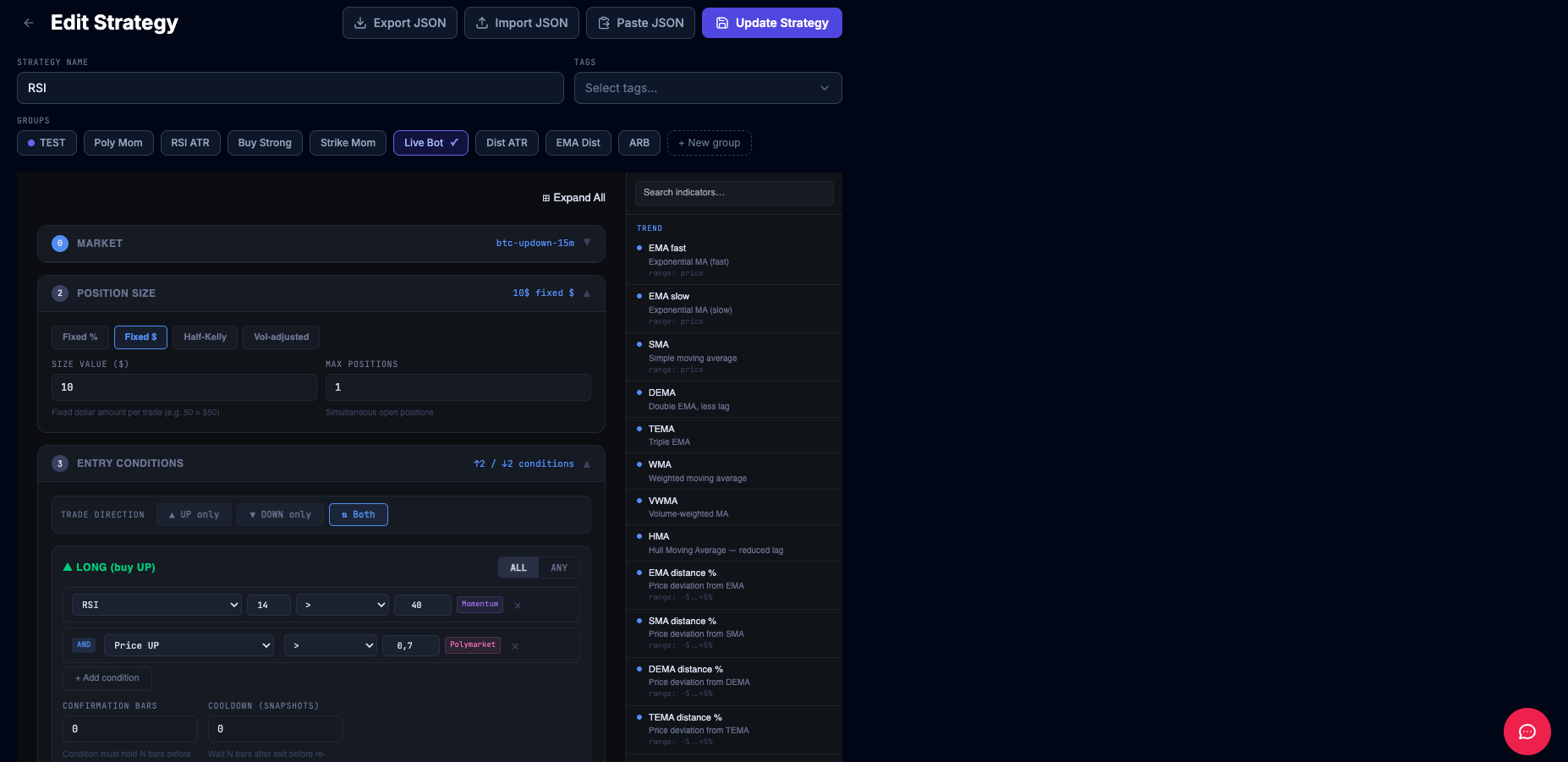 The Up/Down editor: numbered cards on the left, a searchable indicator panel on the right. Here the entry fires on RSI above 40 AND Price UP above 0.7.
The strategy is a stack of cards:
| Card | What you set |
|---|---|
| Market | the coin and contract length (e.g. BTC, 15m) and the Bar interval: raw ticks by default, or bars from 30 seconds to 1 day. With 1-minute bars, RSI(14) means 14 minutes of real time |
| Position size | Fixed % of equity, Fixed $ per trade, or Fixed Shares; and Max positions open at once |
| Entry conditions | trade direction (UP only, DOWN only, Both), conditions combined with ALL or ANY, Confirmation bars, Cooldown after an exit, and the Entry order type |
| Exit conditions | Signal exit by indicator conditions, Take-profit & Stop-loss, or Hold to expiry; exit order type |
| Entry time window | entries only between X% and Y% of the contract’s life; No-trade days (UTC) and No-trade hours (UTC) |
| Market context filters | hard gates: if any fails, no entry. Min volume, Max spread, Vol regime, Time of day, Min order-book depth, Pyramiding, Re-entry in window, Opposite direction, Max entries per window |
| Circuit breakers | stop new entries when equity falls X% from its peak or the day’s loss exceeds X%. Open positions stay open |
Conditions. A simple condition is indicator · operator · threshold, such as RSI(14) > 40. PRO conditions add AND/OR operators between them and “bars ago” to compare with earlier values.
Take-profit and stop-loss are absolute contract prices, not percentages: price_up = 0.75, not “+20%”.
Order types. Market, Limit, Stop-Limit, Post-Only and GTD. Post-only orders pay no taker fee but may be refused if they would match immediately; GTD orders expire on a timer. See Order types.
Indicators for Up/Down
The panel groups indicators by category. Each one has a card with its formula, parameters, typical thresholds and an example.
| Category | Examples |
|---|---|
| Trend | EMA, SMA, DEMA, TEMA, WMA, HMA, VWMA, Ichimoku |
| Trend (% distance) | EMA distance %, SMA distance %: how far price sits from the average |
| Momentum | RSI, Stoch RSI, MACD histogram, CCI, Williams %R, ROC, momentum |
| Volatility | ATR, Bollinger %B and width, Keltner position, Donchian width, realized volatility, vol regime |
| Volume | OBV, VWAP and VWAP deviation, MFI, CMF, relative volume, CVD |
| Polymarket | order-book imbalance, spread, Polymarket RSI and momentum |
| Probability | model estimates of P(UP): Bayesian, Markov, Monte Carlo, ensemble |
| Contract price | price UP / DOWN, best ask, strike price, distance to strike, elapsed % of the contract |
| OHLCV (Binance) | open, high, low, close, volume of the coin’s spot |
| Position state | whether a position is already open on either side |
Two traps to know:
- The threshold must match the indicator’s scale. RSI runs 0–100, price UP 0–1, distance % in percent. A threshold outside the range is simply never true, and the strategy never trades, with no error.
- Always set the period explicitly. If a strategy arrives without a period (imported or edited outside the editor), the engine uses its own default, which can differ from what the editor suggests.
Full list: Indicators reference.
The exchange minimum is 5 shares. A backtest accepts any size, but a live bot with a tiny Fixed $ or fewer than 5 Fixed Shares can’t place orders.
The Multimarket strategy builder
Open it from Algo trading → Strategies (for crypto or stocks) or in the backtester’s Constructor. In the Constructor the builder’s sections appear as cards: What to trade, Entry conditions (or Grid), Exit conditions, Advanced, and Tuning and checks.
What to trade
- Market: Stocks & derivatives, Crypto spot or Crypto futures (USDT perpetuals). Crypto uses pairs like BTCUSDT and fractional amounts; stocks use whole shares and New York sessions.
- Symbols (pairs for crypto). Pairs-trading formulas need exactly two.
- Timeframe: 1m, 2m, 5m, 15m, 30m, 90m, 1h, 1d, 5d, 1wk, 1mo, 3mo.
- Leverage for futures: position = margin × leverage. A move of about 1/leverage against you wipes out the margin. Funding is paid or received at each settlement and counted in results.
- Mode: Orders (rules) places buy and sell orders by your rules; Weights (portfolio) holds target weights and rebalances to them.
- Signal type: your own rules, a ready formula (ranking, risk parity, pairs trading and others, driven by their parameters), or a Grid (see DCA and grid bots).
Conditions
A condition compares two operands with an operator such as >, <, crosses above or crosses below. An operand can be:
- Indicator — from the built-in catalogue or your own.
- Price or a Number.
- Position state — for example, whether you already hold a position.
- Calendar — month, day of month, weekday, trading day of month, trading days to month end, hour, minute, options-expiry week. Hours are New York time for stocks and UTC for crypto. This is how you build time filters: trade only on certain weekdays, hours or around month end.
- Funding rate and Open interest of a perpetual, for crypto futures.
Long and short entries have separate blocks. Conditions combine with AND or OR.
Signals use closed bars. The decision is taken at a bar’s close and the order fills on the next bar. To hold a position on the 16th, set the condition on the 15th.
Exits and orders
- Exit conditions by rule, and protective orders: stop, take-profit, trailing stop, partial takes.
- Order types: Market, Limit, Stop, Stop-limit, Trailing stop, Trailing stop-limit, Bracket (take-profit + stop) and OCO (one cancels the other). Time in force: GTC or DAY.
- Safety orders (DCA) on the entry: add-ons at set steps. See DCA and grid bots.
Fees and slippage
Every strategy carries its own costs. The default is 1 basis point of commission and 5 basis points of slippage. Set your real exchange or broker fee: with zero costs the backtest is optimistic, and the strategy check’s costs gate becomes meaningless.
Indicators and My indicators
Algo trading → Indicators has its own catalogue for crypto and stocks, including candlestick patterns. Each indicator card explains what it shows, how to read it, its parameters and outputs, a ready example condition, and a chart on real candles. Polymarket indicators (probability, strike, UP/DOWN) don’t exist here.
My indicators are your own, built from blocks (what → how → with what, AND/OR, bars back) or as a formula that combines catalogue indicators and functions, with any number turned into a parameter. The formula is checked as you type and previewed on real data. Your indicator is linked, not copied: changing it changes every strategy and bot that uses it, after you confirm.
Indicators read the plain close price adjusted for splits; dividends are counted separately.
Describe in words
You can describe a strategy in plain language and the AI fills in the form. Nothing is saved or run until you check it and save. It only uses indicators from the catalogue and warns about missing entries or exits. If AI isn’t available, start from a library template or build by hand.
What isn’t modelled
Borrow fees on shorts and the cost of leverage aren’t modelled. The order book isn’t modelled either, so intraday fills may be worse in reality. Futures (=F) and FX (=X) symbols are price series for backtests and dry runs only.